
|
|
Evaluating Your Pet
|
Fore limb Strength
After 40 years of making and fitting carts, we are still amazed at how quickly pets adjust to carts,
running off as if they had been born to them. Pets will get around by any means possible, but this can lead to many health problems, as described in our Nursing Care section.
With the exception of mobility-impairment, your pet should be in good general health.
Please checkout Applicable Conditions and read the information provided through the links above, to ensure that your pet is a candidate for one of our mobility aids.
Try and be as objective as you can about your pet’s present physical condition.
If you are in any doubt as to your pet’s ability to handle any of our products, please call and talk with one of our customer service representatives.
We may ask you to take a video of what your pet is capable of doing on its own with a front, rear, or two slings. We will call you promptly with our recommendations.
|
|
back to top
|
Obesity
If your pet is overweight and has mobility problems, it is a difficult situation as weight reduction is hard without exercise.
Diet can only do so much! Obese pets generally have a harder time adjusting to carts and they must be conditioned gradually to avoid stress.
Carts are an important means of rehabilitation. The “Walking” option on the K-9 Cart is very helpful if the pet has minimal rear mobility as it takes the
stress off the back and rear limbs while still allowing the pet to learn to walk again on its rear legs, thus giving it exercise and helping with weight reduction.
If you feel your pet is not strong enough to handle a K-9 Cart then please contact K-9 Carts and one of our qualified staff will go over available options for your pet.
|
|
back to top
|
Desire
Most pets with mobility problems do not realize that they are handicapped and will drag themselves around.
When fitted with a K-9 Cart, they usually adapt quickly and are off and running! However with an older, arthritic, pet, I recommend evaluating what
THEY REALLY WANT TO DO. Keep in mind also that age is a state of mind as we all know animals and humans, age differently.
If your pet is content to lie around in the sun outside or in the house and it only wants to get up for brief periods,
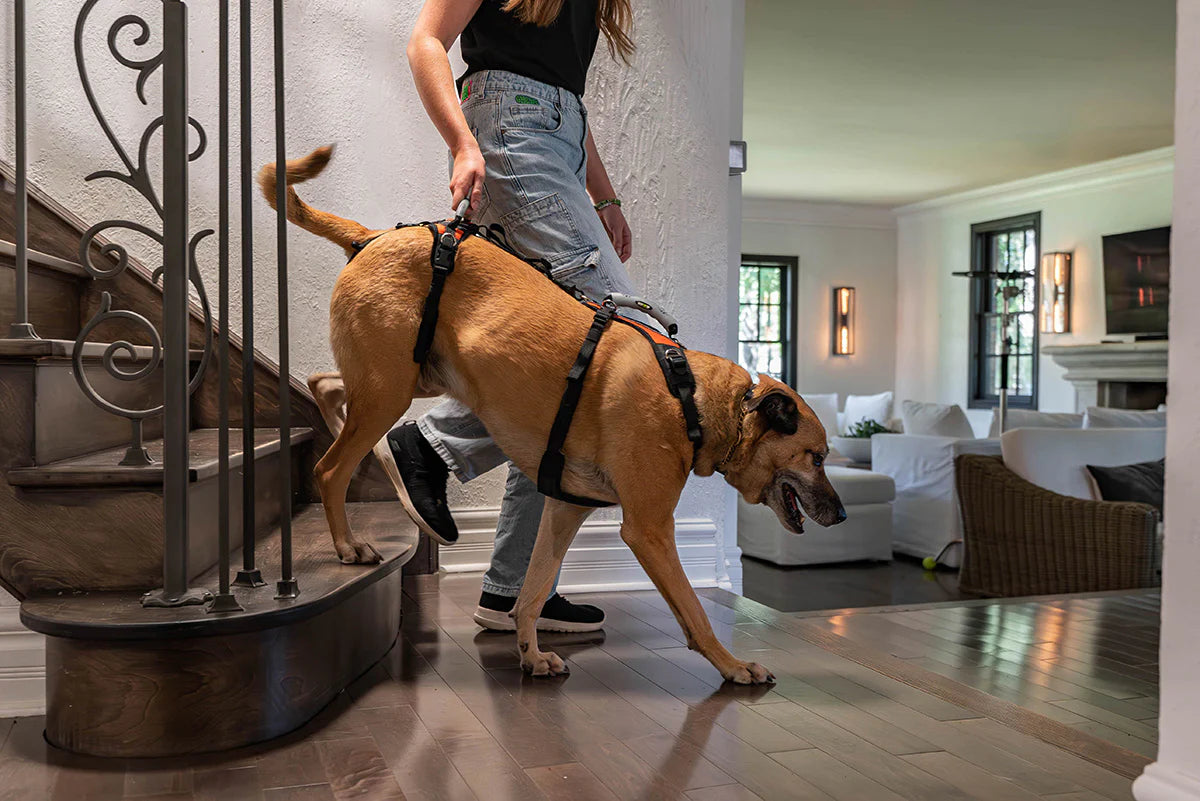
then perhaps all that is needed at this stage of its life is a helping hand with a Walkabout Harness.
However if it is bright and alert, still enjoys a walk and sniffing around in the garden, then a K-9 Cart can provide your pet with an extended, happier, healthier life.
|
|
back to top
|
Disposition
It is extremely rare that a pet will fight a K-9 Cart, or refuse to use one because of a disposition problem.
Only you know if your pet fits into this category. If your pet has always fought the use of a leash, or being handled, then no matter how you may want to help it,
it may be too independent to be put into a cart. Try the “Walking” test (see the Fore limb Strength section) and if it will tolerate this help, then most likely, it should take to a cart.
If you have a pet that is afraid of everything, then you may need to work slowly and gently with your pet to let them become accustomed to use of the cart and the freedom it affords.
A pet that has been “down or paralyzed” for a long period of time, has usually developed its own way of moving around and since they will now be able to run in their cart,
it may take time for them to realize that they are not being “chased” by something. This is particularly applicable to the smaller dogs and cats who may be afraid at first of what is “following them around”.
Again try the “Walking” test for Fore limb Strength and see if it will tolerate that type of help. If you are a getting a cart for your pet, perform this test several times daily.
This will gradually get your pet accustomed to moving in a normal standing position.
Many animals, when given the chance to walk around again with the help of a K-9 Cart, improve not only physically, but mentally.
Therefore, if your pet is in a temporarily depressed state, the mobility a K-9 Cart offers can make a world of difference.
|
|
back to top
|
|
Applicable Conditions
Breed Specific
|